Pages

Showing posts with label Chemistry. Show all posts

Tuesday, 1 October 2013

CHEMISTRY CALCULATIONS


CHEMISTRY CALCULATIONS
There are relatively few calculations on this site, but you might be interested in my chemistry calculations book.
If you have found this site helpful, you should find the book will help you as well.
Don't be misled by the book's title! It was written to cover the calculations in UK AS and A level chemistry syllabuses (roughly for ages 16 - 18 years), but chemistry calculations are just the same wherever in the world you are working.
Each type of calculation is introduced in a very gentle way, making no great assumptions about your chemistry knowledge or maths ability. There are then lots of worked examples, gradually getting more difficult and showing as many variations on a calculation as possible.
At the end of each section there is a set of problems for you to do, based firmly on what has gone before. At the back of the book, you will find complete worked solutions to these problems.
At the end of each chapter, you will find another set of problems covering the ground again. This time, numerical answers are given for the problems - but no worked solutions.
You can explore parts of the book by looking at it on the Amazon site, using the "Click to LOOK INSIDE" feature. That will give you the full contents list and the index, the first 6 pages of Chapter 1, and all the answers to the problems in the book - including the fully worked answers. You can also read all the reviews of the book.

Thursday, 5 September 2013

Saturated Unbranched-chain Compounds and Univalent Radicals

The first four saturated unbranched acyclic hydrocarbons are called methane, ethane, propane and butane. Names of the higher members of this series consist of a numerical term, followed by "-ane" with elision of terminal "a" from the numerical term. Examples of these names are shown in the table below. The generic name of saturated acyclic hydrocarbons (branched or unbranched) is "alkane".
Examples of names:
(n = total number of carbon atoms)
n n
1 Methane 22 Docosane
2 Ethane 23 Tricosane
3 Propane 24 Tetracosane
4 Butane 25 Pentacosane
5 Pentane 26 Hexacosane
6 Hexane 27 Heptacosane
7 Heptane 28 Octacosane
8 Octane 29 Nonacosane
9 Nonane 30 Triacontane
10 Decane 31 Hentriacontane
11 Undecane 32 Dotriacontane
12 Dodecane 33 Tritriacontane
13 Tridecane 40 Tetracontane
14 Tetradecane 50 Pentacontane
15 Pentadecane 60 Hexacontane
16 Hexadecane 70 Heptacontane
17 Heptadecane 80 Octacontane
18 Octadecane 90 Nonacontane
19 Nonadecane 100 Hectane
20 Icosane 132 Dotriacontahectane
21 Henicosane
1.2 - Univalent radicals derived from saturated unbranched acyclic hydrocarbons by removal of hydrogen from a terminal carbon atom are named by replacing the ending "-ane" of the name of the hydrocarbon by "-yl". The carbon atom with the free valence is numbered as 1. As a class, these radicals are called normal, or unbranched chain, alkyls.
Examples to Rule A-1.2

Basic IUPAC Organic Nomenclature

IUPAC Nomenclature
IUPAC nomenclature uses the longest continuous chain of carbon atoms to determine the basic root name of the compound.
The root name is then modified due to the presence of different functional groups which replace hydrogen or carbon atoms in the parent sturcture.
There are a number of different ways to modify the root name to indicate the functional groups present.
  • Substitutive : (most common) : the highest priority functional group modifies the suffix of the root name, while all other groups, or substituents, are added as prefixes to the root name.
  • Functional group : names the compound based on the highest priority functional group, i.e. as an alcohol, ketone, alkyl halide, etc.
  • Replacement : used to indicate when an atom, usually carbon, is replaced by another atom.
  • Conjunctive : used to combine named subunits (i.e. cyclohexanecarboxylic acid).
  • Common or trivial : due to widespread use, some compunds with simple names have been adopted into basic IUPAC nomenclature

Nomenclature of Organic Chemistry

Chemical Nomenclature and Structure Representation Division
For nomenclature purposes, a structure containing at least one carbon atom is considered to be an organic compound. The formation of a systematic name for an organic compound requires selection and then naming of a parent structure. This basic name may then be modified by prefixes, infixes, and, in the case of a parent hydride, suffixes, which convey precisely the structural changes required to generate the compound in question from the parent structure. In contrast to such systematic names, there are traditional names which are widely used in industry and academic circles. Examples are acetic acid, benzene and pyridine. Therefore, when they meet the requirements of utility and when they fit into the general pattern of systematic nomenclature, these traditional names are retained.
A major new principle is elaborated in these Recommendations. The concept of ‘preferred IUPAC names’ is developed and systematically applied. Up to now, the nomenclature developed and recommended by IUPAC has emphasized the generation of unambiguous names in accord with the historical development of the subject. In 1993, due to the explosion in the circulation of information and the globalization of human activities, it was deemed necessary to have a common language that will prove important in legal situations, with manifestations in patents, export-import regulations, environmental and health and safety information, etc. However, rather than recommend only a single ‘unique name’ for each structure, we have developed rules for assigning ‘preferred IUPAC names’, while continuing to allow alternatives in order to preserve the diversity and adaptability of the nomenclature to daily activities in chemistry and in science in general.
Thus, the existence of preferred IUPAC names does not prevent the use of other names to take into account a specific context or to emphasize structural features common to a series of compounds. Preferred IUPAC names belong to ‘preferred IUPAC nomenclature’ Any name other than a preferred IUPAC name, as long as it is unambiguous and follows the principles of the IUPAC recommendations herein, is acceptable as a ‘general’ IUPAC name, in the context of ‘general’ IUPAC nomenclature. The concept of preferred IUPAC names is developed as a contribution to the continuing evolution of the IUPAC nomenclature of organic compounds. This book (Recommendations 2004) covers and extends the principles, rules and conventions described in two former publications: Nomenclature of Organic Chemistry, 1979 Edition and A Guide to IUPAC Nomenclature of Organic Compounds, Recommendations 1993. In a few instances, the 1979 rules and the 1993 recommendations have been modified to achieve consistency within the entire system. In case of divergence among the various recommendations, Recommendations 2004 prevail.
Download full text of the Provisional Recommendations from the contents below. Alternatively, and to facilitate full text searching, the whole volume as single pdf is also available [pdf - 10.34MB]. 
Read more at:

Metals with More than One Oxidation State

Some Common Metals with More than One Oxidation State
Family Element Ion Name
VIB Chromium Chromium(II) or chromous
Chromium(III) or chromic
VIIB Manganese Manganese(II) or manganous
Manganese(III) or manganic
VIIIB Iron Iron(II) or ferrous
Iron(III) or ferric
Cobalt Cobalt(II) or cobaltous
Cobalt(III) or cobaltic
IB Copper Copper(I) or cuprous
Copper(II) or cupric
IIB Mercury Mercury(I) or mercurous
Mercury(II) or mercuric
IVA Tin Tin(II) or stannous
Tin(IV) or stannic
Lead Lead(II) or plumbous
Lead(IV) or plumbic

Names, formulas and charges of the most common ions

Names, formulas and charges
of the most common ions

Positive Ions (cations)
Aluminum Al 3+ 
Ammonium NH4 +
Antimony (III) Sb3+
Antimony (V) Sb5+
Arsenic (III) As3+
Arsenic (V) As5+
Barium Ba2+
Beryllium Be2+
Bismuth (III) Bi3+
Bismuth (V) Bi5+
Cadmium Cd2+
Calcium Ca 2+ 
Chromium (II) Cr 2+ 
Chromium (III) Cr 3+ 
Cobalt (II) Co 2+ 
Cobalt (III) Co 3+ 
Copper (I) Cu
Copper (II) Cu 2+ 
Hydrogen, hydronium ** H + , H3O
Iron (II) Fe 2+ 
Iron (III) Fe 3+ 
Lead (II) Pb 2+ 
Lead (IV) Pb 4+ 
Lithium Li
Magnesium Mg 2+ 
Manganese (II) Mn 2+ 
Manganese (IV) Mn 4+ 
Mercury (I)* Hg2 2+ 
Mercury (II) Hg 2+ 
Nickel Ni 2+ 
Oxonium ** H3O
Potassium K
Scandium Sc 2+ 
Silver Ag +
Sodium Na
Strontium Sr 2+ 
Tin (II) Sn 2+ 
Tin (IV) Sn 4+ 
Zinc Zn 2+ 
* Mercury (I) ions occur as groups of 2,
its symbol is Hg2and its total charge is +2.
** The use of "Oxonium" is recommanded
instead of hydronium or hydroxonium.


Negative Ions (anions)
Acetate CH3COO-
Borate BO3 3-
Bromate BrO3 -
Bromide Br -
Carbonate CO3 2-
Chlorate ClO3 -
Chloride Cl -
Chlorite ClO2-
Chromate CrO42-
Cyanamide CN22-
Cyanide CN-
Dichromate Cr2O72-
Dihydrogen phosphate H2PO4-
Ferricyanide Fe(CN)63-
Ferrocyanide Fe(CN)64-
Fluoride F -
Hydrogen carbonate HCO3-
Hydrogen phosphate HPO42-
Hydrogen sulfate HSO4-
Hydrogen sulfide HS-
Hydrogen sulfite HSO3-
Hydride H-
Hydroxide OH-
Hypochlorite ClO-
Iodate IO3 -
Iodide I -
Nitrate NO3-
Nitride N3-
Nitrite NO2-
Oxalate C2O42-
Oxide O2-
Perchlorate ClO4-
Permanganate MnO4-
Peroxide O22-
Phosphate PO43-
Phosphide P3-
Phosphite PO33-
Silicate SiO44-
Stannate SnO32-
Stannite SnO22-
Sulfate SO42-
Sulfide S2-
Sulfite SO32-
Tartrate C4H4O62-
Thiocynate SCN-

Saturday, 20 April 2013

pH: ACIDS VERSUS BASES

Measure of Hydrogen Ions (H+) in solution: The more Hydrogen Ions (H+) there are the more acidic a solution is.
Water
Where do Hydrogen Ions (H+) come from? Well, it's all part of water really...
  • Water (H2O) splits into Hydrogen Ions (H+) and Hydroxyl Ions (OH-).
  • When there are equal parts of Hydrogen Ions (H+) and Hydroxyl Ions (OH-) leading to a 1:1 ratio, pH is neutral (7).
Sometimes other chemicals are present that are dissolved by water. The pieces that result may contain an Hydrogen Ion (H+) or Hydroxyl Ion (OH-). This will change the pH.
Acids
Acids add Hydrogen Ions (H+) to solutions.
  • Hydrochloric acid (HCl) splits into Hydrogen Ions (H+) and Chloride Ions (Cl-). 
  • Extra H+ means acid solution  (no more equal parts).
  • the 1:1 ratio is changed, now there are too many H+, it turns acidic.
Bases
Bases add Hydroxyl Ion (OH-) to solutions.
  • Sodium Hydroxide Solution (NaOH) splits into Sodium (Na+) and Hydroxyl Ions (OH-).
  • Extra Hydroxyl Ions (OH-) shifts ratio (fewer free H+ than normal).
  • the 1:1 ratio is changed, now there are too few Hydrogen (H+) and there are "extra" OH- ions.
  • The solution becomes basic.
Anything that's too acidic or too basic will degrade organic matter. Tissues are destroyed, cells will die or at least not function properly.

CHEMICAL BONDING

Chemical bonds are formed when the electrons in an atom interact with the electrons in another atom. This allows for the formation of more complex molecules.
There are 3 types of chemical bonds:
  Bond Strength Description Example
Covalent Strong Two atoms share electrons. Bonding of Oxygen and Hydrogen in H2O
Ionic Moderate Oppositely charged ions are attracted to each other. Bond between Na+ and Cl- in salt.
Hydrogen Weak Forms between oppositely charges portions of covalently bonded hydrogen atoms. Bonds between water molecules.
Covalent
These strong bonds form when two atoms share electrons.
Sometimes the electrons in an atom get shared. It's much like when you were a kid and got to sleep over at a friends house. Your friends parents were in charge of you both for one night and the next night you would sleep over at your house and your own parents would be in charge. This sharing of responsibility is functionally similar to the way covalent bonding works.
Normally this sharing is an equal proposition. Sometimes it's not equal (but that gets us into hydrogen bonding discussed below.)
Ionic
Atoms gain or lose electron (opposites attract)
Ions have positive or negative charges. In dating situations, you may know that sometimes opposites attract. In Chemistry, opposites ALWAYS attract. This forms an ionic bond between two atoms.
Hydrogen
Weakest bond between atoms
Occurs in molecules that have covalent bonds. Sometimes the electrons are not equally shared; one atom tends to have an electron more often than the other atom. In this situation one atom of the molecule becomes partly negative and the other then becomes partly positive.
Now we have positive and negative things becoming attracted to each other. (remember ionic bonds?) This is especially common between water molecules.

Saturday, 16 March 2013

Intraduction to the Atoms

All matter consists of particles called atoms. This is a list of the basic characteristics of atoms:
  • Atoms cannot be divided using chemicals. They do consist of parts, which include protons, neutrons, and electrons, but an atom is a basic chemical building block of matter.
  • Each electron has a negative electrical charge.
  • Each proton has a positive electrical charge. The charge of a proton and an electron are equal in magnitude, yet opposite in sign. Electrons and protons are electrically attracted to each other.
  • Each neutron is electrically neutral. In other words, neutrons do not have a charge and are not electrically attracted to either electrons or protons.
  • Protons and neutrons are about the same size as each other and are much larger than electrons. The mass of a proton is essentially the same as that of a neutron. The mass of a proton is 1840 times greater than the mass of an electron.
  • The nucleus of an atom contains protons and neutrons. The nucleus carries a positive electrical charge.
  • Electrons move around outside the nucleus.
  • Almost all of the mass of an atom is in its nucleus; almost all of the volume of an atom is occupied by electrons.
  • The number of protons (also known as its atomic number) determines the element. Varying the number of neutrons results in isotopes. Varying the number of electrons results in ions. Isotopes and ions of an atom with a constant number of protons are all variations of a single element.
  • The particles within an atom are bound together by powerful forces. In general, electrons are easier to add or remove from an atom than a proton or neutron. Chemical reactions largely involve atoms or groups of atoms and the interactions between their electrons.
Does the atomic theory make sense to you? If so, here's a quiz you can take to test your understanding of the concepts.

What Is Chemistry and way study chemistry

Chemistry is the study of matter and energy and the interactions between them. This is also the definition for physics, by the way. Chemistry and physics are specializations of physical science. Chemistry tends to focus on the properties of substances and the interactions between different types of matter, particularly reactions that involve electrons. Physics tends to focus more on the nuclear part of the atom, as well as the subatomic realm. Really, they are two sides of the same coin.
The formal definition of chemistry is probably what you want to use if you're asked this question on a test.
Because understanding chemistry helps you to understand the world around you. Cooking is chemistry. Everything you can touch or taste or smell is a chemical. When you study chemistry, you come to understand a bit about how things work. Chemistry isn't secret knowledge, useless to anyone but a scientist. It's the explanation for everyday things, like why laundry detergent works better in hot water or how baking soda works or why not all pain relievers work equally well on a headache. If you know some chemistry, you can make educated choices about everyday products that you use.
What Fields of Study Use Chemistry?
You could use chemistry in most fields, but it's commonly seen in the sciences and in medicine. Chemists, physicists, biologists, and engineers study chemistry. Doctors, nurses, dentists, pharmacists, physical therapists, and veterinarians all take chemistry courses. Science teachers study chemistry. Fire fighters and people who make fireworks learn about chemistry. So do truck drivers, plumbers, artists, hairdressers, chefs... the list is extensive.
What Do Chemists Do?
Whatever they want. Some chemists work in a lab, in a research environment, asking questions and testing hypotheses with experiments. Other chemists may work on a computer developing theories or models or predicting reactions. Some chemists do field work. Others contribute advice on chemistry for projects. Some chemists write. Some chemists teach. The career options are extensive.
Where Can I Get Help With a Chemistry Science Fair Project?
There are several sources for help. A good starting point is the Science Fair Index on this website. Another excellent resource is your local library. Also, do a search for a topic that interests you using a search engine, such as Google

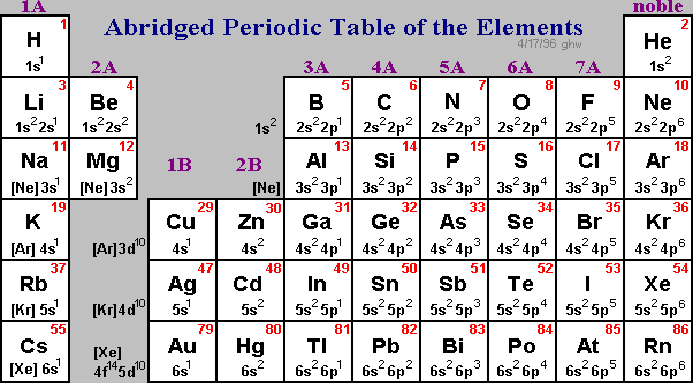
Periodic Table Of the Elements


Sample text

Sample Text