|
MASS SPECTRA - THE M+2 PEAK
This page explains how the M+2 peak in a mass spectrum arises from
the presence of chlorine or bromine atoms in an organic compound. It
also deals briefly with the origin of the M+4 peak in compounds
containing two chlorine atoms. | |
|
Note: Before you start this page, it would be a good idea to have a reasonable understanding about how a mass spectrum is produced and the sort of information you can get from it. If you haven't already done so, explore the mass spectrometry menu before you go on. | |
|
The effect of chlorine or bromine atoms on the mass spectrum of an organic compound
Compounds containing chlorine atoms One chlorine atom in a compound 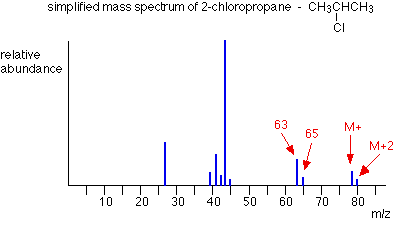 | |
|
Note: All the mass spectra on this page have been drawn using data from the Spectral Data Base System for Organic Compounds (SDBS) at the National Institute of Materials and Chemical Research in Japan. With one exception, they have been simplified by omitting all the minor lines with peak heights of 2% or less of the base peak (the tallest peak). | |
|
The molecular ion peaks (M+ and M+2) each contain one chlorine atom -
but the chlorine can be either of the two chlorine isotopes, 35Cl and 37Cl. The molecular ion containing the 35Cl isotope has a relative formula mass of 78. The one containing 37Cl has a relative formula mass of 80 - hence the two lines at m/z = 78 and m/z = 80. Notice that the peak heights are in the ratio of 3 : 1. That reflects the fact that chlorine contains 3 times as much of the 35Cl isotope as the 37Cl one. That means that there will be 3 times more molecules containing the lighter isotope than the heavier one. So . . . if you look at the molecular ion region, and find two peaks separated by 2 m/z units and with a ratio of 3 : 1 in the peak heights, that tells you that the molecule contains 1 chlorine atom. You might also have noticed the same pattern at m/z = 63 and m/z = 65 in the mass spectrum above. That pattern is due to fragment ions also containing one chlorine atom - which could either be 35Cl or 37Cl. The fragmentation that produced those ions was:   | |
|
Note: If you aren't sure about fragmentation you might like to have a look at this link. | |
Two chlorine atoms in a compound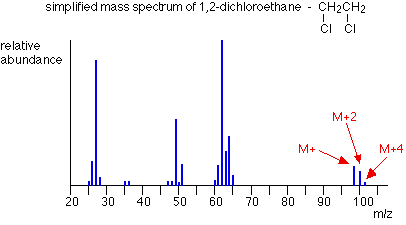 | |
|
Note: This spectrum has been simplified by omitting all the minor lines with peak heights of less than 1% of the base peak (the tallest peak). This contains more minor lines than other mass spectra in this section. It was necessary because otherwise an important line in the molecular ion region would have been missing. | |
The lines in the molecular ion region (at m/z values of 98, 100 ands
102) arise because of the various combinations of chlorine isotopes that
are possible. The carbons and hydrogens add up to 28 - so the various
possible molecular ions could be:
So . . . if you have 3 lines in the molecular ion region (M+, M+2 and M+4) with gaps of 2 m/z units between them, and with peak heights in the ratio of 9:6:1, the compound contains 2 chlorine atoms. Compounds containing bromine atoms Bromine has two isotopes, 79Br and 81Br in an approximately 1:1 ratio (50.5 : 49.5 if you want to be fussy!). That means that a compound containing 1 bromine atom will have two peaks in the molecular ion region, depending on which bromine isotope the molecular ion contains. Unlike compounds containing chlorine, though, the two peaks will be very similar in height. 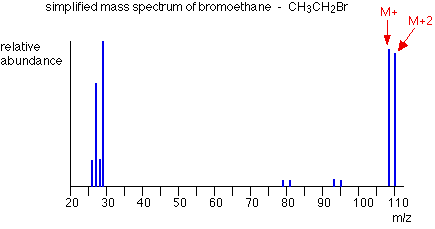
| |
Showing posts with label Physical chemistry. Show all posts
Showing posts with label Physical chemistry. Show all posts
Tuesday, 1 October 2013
MASS SPECTRA - THE M+2 PEAK

SOLUBILITY PRODUCT and THE COMMON ION EFFECT
|
SOLUBILITY PRODUCT and THE COMMON ION EFFECT
This page looks at the common ion effect related to solubility
products, including a simple calculation. You need to know about
solubility products and calculations involving them before you read this
page. What is the common ion effect? I need to look again at a simple solubility product calculation, before we go on to the common ion effect. The solubility of lead(II) chloride in water Lead(II) chloride is sparingly soluble in water, and this equilibrium is set up between the solid and its ions in solution:   If you just shook up some solid lead(II) chloride with water, then the solution would obviously contain twice as many chloride ions as lead(II) ions. The expression for the solubility product and its value are given by: 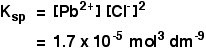 | |
|
Note: I have no confidence in the accuracy of this value. There are serious discrepancies between the values from different sources. But that makes no difference to the discussion. | |
|
For comparison purposes later, I need to work out the lead(II) ion concentration in this saturated solution. If the concentration of dissolved lead(II) chloride is s mol dm-3, then: [Pb2+] = s mol dm-3[Cl- ] = 2s mol dm-3Put these values into the solubility product expression, and do the sum. 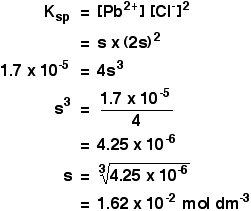 So the concentration of lead(II) ions in the solution is 1.62 x 10⁻² mol dm-3 (or 0.0162 mol dm-3 if you prefer). What happens if you add some sodium chloride to this saturated solution? Now we are ready to think about the common ion effect. Sodium chloride shares an ion with lead(II) chloride. The chloride ion is common to both of them. This is the origin of the term "common ion effect". Look at the original equilibrium expression again: What would happen to that equilibrium if you added extra chloride ions? According to Le Chatelier, the position of equilibrium would shift in order to counter what you have just done. In this case, it would tend to remove the chloride ions by making extra solid lead(II) chloride. | |
|
Note: Actually, of course, the concentration of lead(II) ions in the solution is so small to start with, that only a tiny proportion of the extra chloride ions can be converted into solid lead(II) chloride. | |
|
The lead(II) chloride will become even less soluble - and, of course,
the concentration of lead(II) ions in the solution will decrease. Something similar happens whenever you have a sparingly soluble substance. It will be less soluble in a solution which contains any ion which it has in common. This is the common ion effect. A simple calculation to show this Suppose you tried to dissolve some lead(II) chloride in some 0.100 mol dm-3 sodium chloride solution instead of in water. What would the concentration of the lead(II) ions be this time? As before, let's call the concentration of the lead(II) ions s. [Pb2+] = s mol dm-3Now the sum gets different. This time the concentration of the chloride ions is governed by the concentration of the sodium chloride solution. The number of ions coming from the lead(II) chloride is going to be tiny compared with the 0.100 mol dm-3 coming from the sodium chloride solution. In calculations like this, you can always assume that the concentration of the common ion is entirely due to the other solution. This makes the maths a lot easier. In fact if you don't make this assumption, the maths of this can become impossible to do at this level. So we assume: [Cl- ] = 0.100 mol dm-3The rest of the sum looks like this: 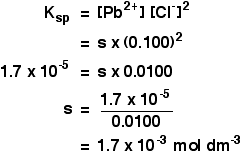 Finally, compare that value with the simple saturated solution we started with: Original solution: [Pb2+] = 0.0162 mol dm-3Solution in 0.100 mol dm-3 NaCl solution: [Pb2+] = 0.0017 mol dm-3The concentration of the lead(II) ions has fallen by a factor of about 10. If you tried the same sum with more concentrated solutions of sodium chloride, the solubility would fall still further. Try it yourself with chloride ion concentrations of 0.5 and 1.0 mol dm-3. | |
SOLUBILITY PRODUCT CALCULATIONS
|
SOLUBILITY PRODUCT CALCULATIONS
This page is a brief introduction to solubility product calculations. These are covered in more detail in my chemistry calculations book. Calculating solubility products from solubilities I am going to assume that you are given the solubility of an ionic compound in mol dm-3. If it was in g dm-3, or any other concentration units, you would first have to convert it into mol dm-3. Example 1 The solubility of barium sulphate at 298 K is 1.05 x 10⁻⁵ mol dm-3. Calculate the solubility product. The equilibrium is:  Notice that each mole of barium sulphate dissolves to give 1 mole of barium ions and 1 mole of sulphate ions in solution. That means that: [Ba2+] = 1.05 x 10⁻⁵ mol dm-3[SO42-] = 1.05 x 10⁻⁵ mol dm-3All you need to do now is to put these values into the solubility product expression, and do the simple sum. 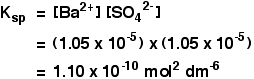 Don't forget to work the units out. | |
|
Important: Get your calculator and work this out! Students frequently mis-enter numbers like 1.05 x 10⁻⁵. If you try this sum, and get a different answer, then you are probably misusing the EXP button. To enter this number, you would enter 1.05, press the EXP button, and then enter -5 (probably by entering 5 and then pressing the +/- button). People often try to enter x 10 in the middle of this process as well. The EXP button includes this. | |
|
Example 2 These calculations are very simple if you have a compound in which the numbers of positive and negative ions are 1 : 1. This next example shows you how to cope if the ratio is different. The solubility of magnesium hydroxide at 298 K is 1.71 x 10⁻⁴ mol dm-3. Calculate the solubility product. The equilibrium is:  For every mole of magnesium hydroxide that dissolves, you will get one mole of magnesium ions, but twice that number of hydroxide ions. So the concentration of the dissolved magnesium ions is the same as the dissolved magnesium hydroxide: [Mg2+] = 1.71 x 10⁻⁴ mol dm-3The concentration of dissolved hydroxide ions is twice that: [OH-] = 2 x 1.71 x 10-4 = 3.42 x 10⁻⁴ mol dm-3Now put these numbers into the solubility product expression and do the sum. 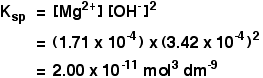 Calculating solubilities from solubility products Reversing the sums we have been doing isn't difficult as long as you know how to start. We will take the magnesium hydroxide example as above, but this time start from the solubility product and work back to the solubility. If the solubility product of magnesium hydroxide is 2.00 x 10⁻¹¹ mol3 dm-9 at 298 K, calculate its solubility in mol dm-3 at that temperature. The trick this time is to give the unknown solubility a symbol like x or s. I'm going to choose s, because an x looks too much like a multiplication sign. If the concentration of dissolved magnesium hydroxide is s mol dm-3, then: [Mg2+] = s mol dm-3[OH-] = 2s mol dm-3Put these values into the solubility product expression, and do the sum. 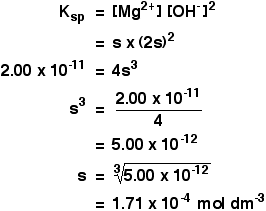 | |
AN INTRODUCTION TO SOLUBILITY PRODUCTS
|
AN INTRODUCTION TO SOLUBILITY PRODUCTS
This page looks at how solubility products are defined, together with
their units. It also explores the relationship between the solubility
product of an ionic compound and its solubility. What are solubility products, Ksp? Solubility products are equilibrium constants Barium sulphate is almost insoluble in water. It isn't totally insoluble - very, very small amounts do dissolve. That's true of any so-called "insoluble" ionic compound. if you shook some solid barium sulphate with water, a tiny proportion of the barium ions and sulphate ions would break away from the surface of the solid and go into solution. Over time, some of these will return from solution to stick onto the solid again. You get an equilibrium set up when the rate at which some ions are breaking away is exactly matched by the rate at which others are returning. The position of this equilibrium lies very far to the left. The great majority of the barium sulphate is present as solid. In fact, if you shook solid barium sulphate with water you wouldn't be aware just by looking at it that any had dissolved at all. But it is an equilibrium, and so you can write an equilibrium constant for it which will be constant at a given temperature - like all equilibrium constants. The equilibrium constant is called the solubility product, and is given the symbol Ksp.  To avoid confusing clutter, solubility product expressions are often written without the state symbols. Even if you don't write them, you must be aware that the symbols for the ions that you write are for those in solution in water.  Why doesn't the solid barium sulphate appear in the equilibrium expression? For many simple equilibria, the equilibrium constant expression has terms for the right-hand side of the equation divided by terms for the left-hand side. But in this case, there is no term for the concentration of the solid barium sulphate. Why not? This is a heterogeneous equilibrium - one which contains substances in more than one state. In a heterogeneous equilibrium, concentration terms for solids are left out of the expression. | |
|
Note: The simplest explanation for this is that the concentration of a solid can be thought of as a constant. Rather than have an expression with two constants in it (the equilibrium constant and the concentration of the solid), the constants are merged to give a single value - the solubility product. | |
|
Solubility products for more complicated solids Here is the corresponding equilibrium for calcium phosphate, Ca3(PO4)2:  And this is the solubility product expression:  Just as with any other equilibrium constant, you raise the concentrations to the power of the number in front of them in the equilibrium equation. There's nothing new here. Solubility products only apply to sparingly soluble ionic compounds You can't use solubility products for normally soluble compounds like sodium chloride, for example. Interactions between the ions in the solution interfere with the simple equilibrium we are talking about. The units for solubility products The units for solubility products differ depending on the solubility product expression, and you need to be able to work them out each time. Working out the units in the barium sulphate case Here is the solubility product expression for barium sulphate again: Each concentration has the unit mol dm-3. So the units for the solubility product in this case will be: (mol dm-3) x (mol dm-3)= mol2 dm-6Working out the units in the calcium phosphate case Here is the solubility product expression for calcium phosphate again: The units this time will be: (mol dm-3)3 x (mol dm-3)2= (mol dm-3)5= mol5 dm-15If you are asked to calculate a solubility product in an exam, there will almost certainly be a mark for the correct units. It isn't very hard - just take care! Solubility products apply only to saturated solutions Let's look again at the barium sulphate case. Here is the equilibrium expression again: . . . and here is the solubility product expression: Ksp for barium sulphate at 298 K is 1.1 x 10⁻¹⁰ mol2 dm-6. In order for this equilibrium constant (the solubility product) to apply, you have to have solid barium sulphate present in a saturated solution of barium sulphate. That's what the equilibrium equation is telling you. If you have barium ions and sulphate ions in solution in the presence of some solid barium sulphate at 298 K, and multiply the concentrations of the ions together, your answer will be 1.1 x 10⁻¹⁰ mol2 dm-6. What if you mixed incredibly dilute solutions containing barium ions and sulphate ions so that the product of the ionic concentrations was less than the solubility product? All this means is that you haven't got an equilibrium. The reason for that is that there won't be any solid present. If you lower the concentrations of the ions enough, you won't get a precipitate - just a very, very dilute solution of barium sulphate. So it is possible to get an answer less than the solubility product when you multiply the ionic concentrations together if the solution isn't saturated. Can you get an answer greater than the solubility product if you multiply the ionic concentrations together (allowing for any powers in the solubility product expression, of course)? No! The solubility product is a value which you get when the solution is saturated. If there is any solid present, you can't dissolve any more solid than there is in a saturated solution. | |
|
Note: In the absence of any solid, a few substances produce unstable supersaturated solutions. As soon as you add any solid, or perhaps just scratch the glass to give a rough bit that crystals can form on, all the excess solid precipitates out to leave a normal saturated solution. | |
|
If you mix together two solutions containing barium ions and sulphate
ions and the product of the concentrations would exceed the solubility
product, you get a precipitate formed. Enough solid is produced to
reduce the concentrations of the barium and sulphate ions down to a
value which the solubility product allows. | |
Subscribe to:
Posts (Atom)


